← Our guidesCity guide · Spain
Seville & Andalusia, from patios to azulejos
Our complete guide to Andalusia organised by stage: Seville and its districts, Cordoba and its mosque-cathedral, Granada and the Alhambra, Malaga, Ronda and the white villages.
Andalusia is crossed patio by patio, from one caliphal capital to the next.
Seville and its baroque fervour, Cordoba and its mosque-cathedral, Granada and the Alhambra, Malaga between sea and mountains, then Ronda and the white villages of the Sierra: this loop route concentrates eight centuries of al-Andalus.
01
Seville — between azulejos and orange trees
Santa Cruz · Triana · Centro
The Andalusian capital, between whitewashed lanes, secret patios and flamenco born in its outskirts.
The Jewish quarter
Santa Cruz
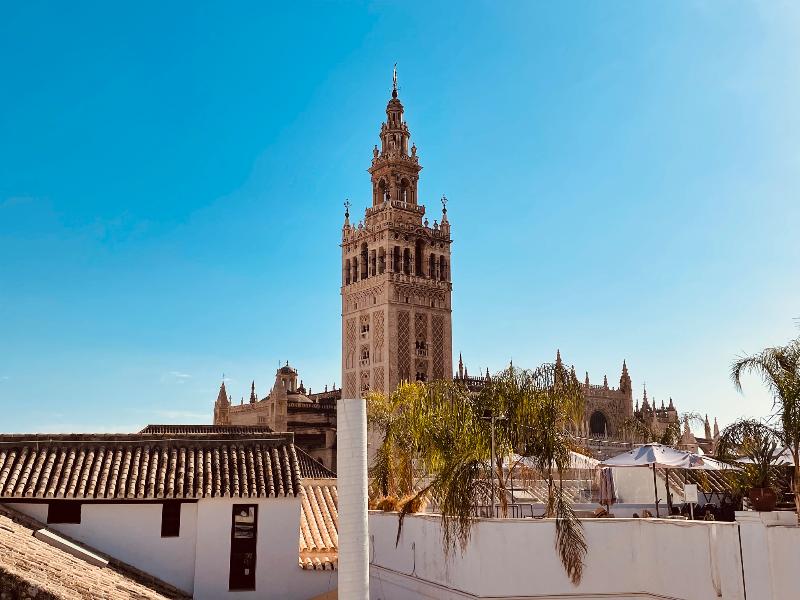
The maze of whitewashed lanes in Santa Cruz holds most of monumental Seville. The cathedral (Av. de la Constitución, 10:45am–5pm on weekdays, 2:30pm–6:30pm on Sundays) and its Giralda tower are best visited late morning; booking online avoids the queue. Around it: plaza del Triunfo, the Edificio La Adriática, plaza de Santa Marta, the monument to John Paul II and the General Archive of the Indies.
- Book the cathedral online
- Morning, before the heat
Alcázar and gardens
The historic quarter
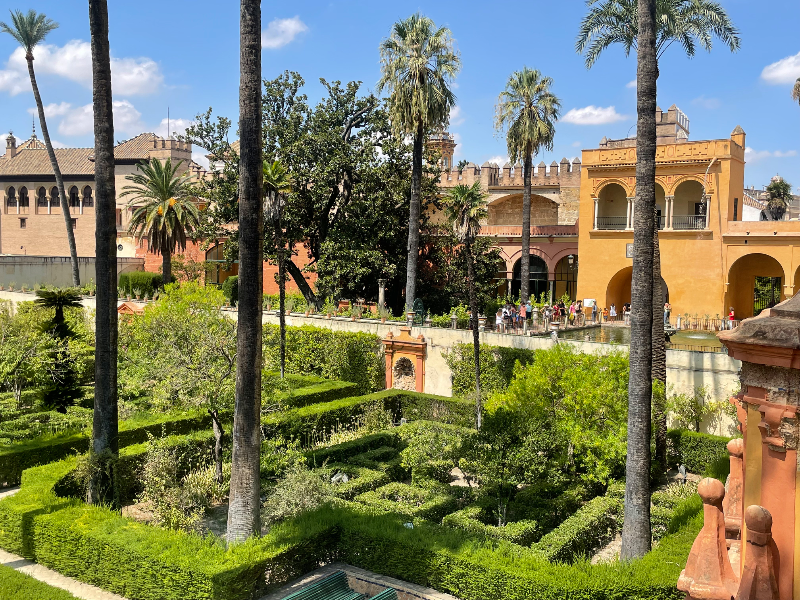
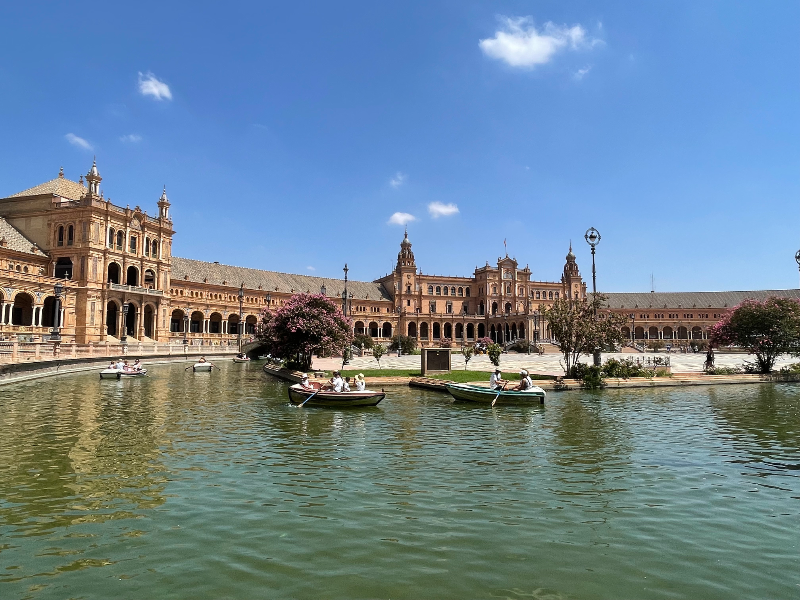
The Alcázar (Patio de Banderas, 9:30am–5pm, €13.50, book online) and its Reales Alcázares gardens fill a half-day, with a break at the Real Fábrica de Tabaco. Continue on to Plaza de España, a legacy of the 1929 Exposition, then Maria Luisa Park and Plaza de América.
The bank of the Guadalquivir
Triana
Across the river, Triana is best explored on foot from the Torre del Oro and paseo de Las Delicias, crossing the Isabel II bridge to the Triana market on calle San Jorge. Long the neighbourhood of boatmen, Roma families and potters, it gave birth to the tradition of Sevillian ceramics in the workshops of calle Alfarería, some of which, like Santa Ana, can still be visited. Just behind the market, calle Betis runs along the river facing the old town — one of the best spots to watch the sunset over the Torre del Oro and the Giralda.
The shopping heart
Centro
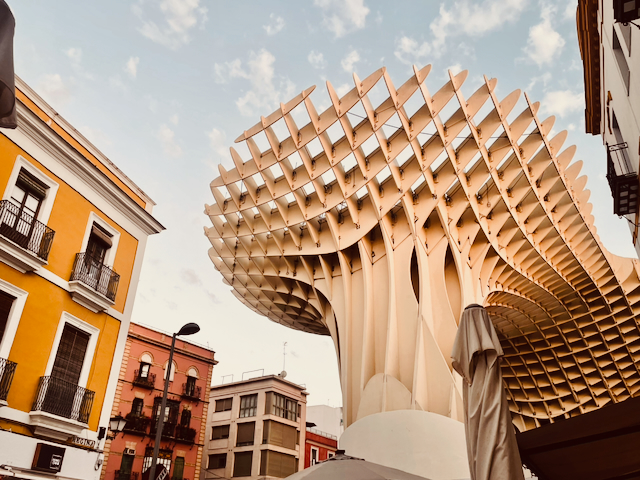
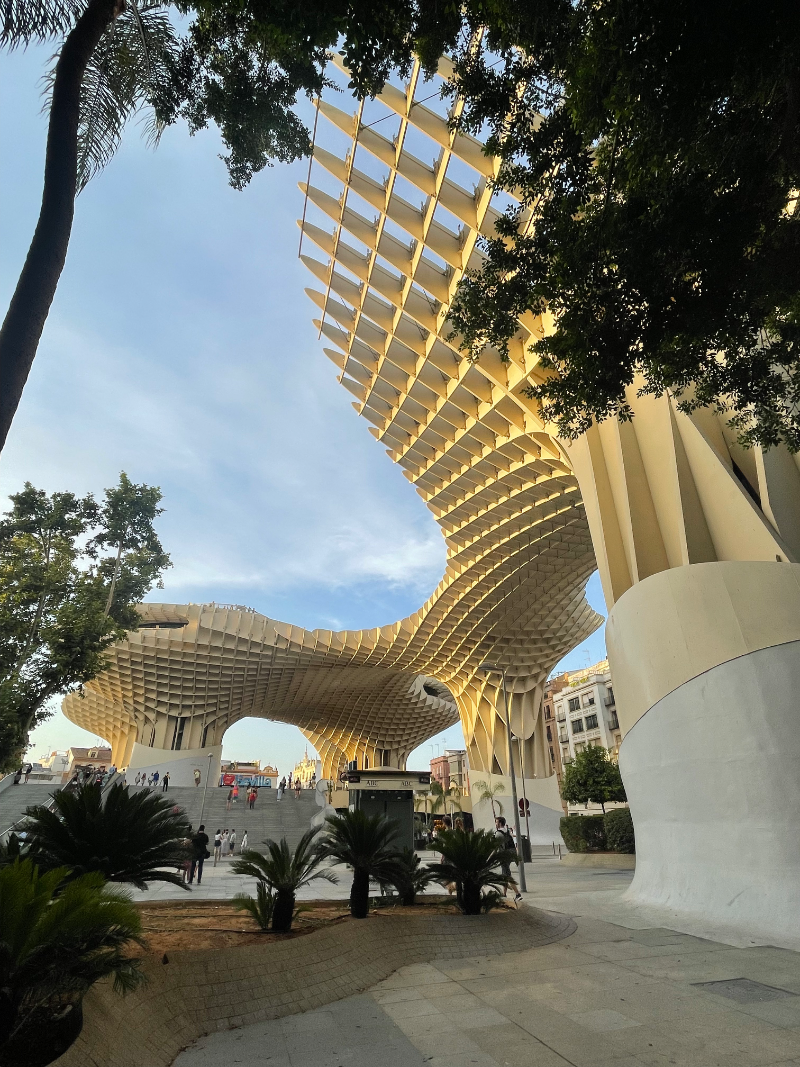
Plaza Nueva and calle Sierpes open onto the shopping centre: the Colegio del Salvador church, the Macarena basilica, and above all the Setas de Sevilla (Metropol Parasol), whose lift ticket is bought in the basement. A good walking thread: avenue de la Constitution → town hall → plaza San Francisco → Edificio de l'Adriática → plaza del Salvador. For shopping: calle Tetuán, calle Sierpes (traditional shops) and calle Cuña (bridal and flamenco dresses).

A living art
Flamenco, born in the streets of Triana
Flamenco took shape in the working-class outskirts of Triana and Santa Cruz, at the crossroads of Roma, Andalusian and Moorish cultures. The cante jondo ("deep song") is its matrix: a raw voice, carried by guitar and compás, speaking of exile, love or mourning before the baile — the dance — takes over. A touristy tablao offers a spectacular glimpse of the art; a peña flamenca, one of these members' clubs where amateurs and local artists gather, offers a more intimate, less staged evening. In Seville, the Triana district remains the best place to feel this living culture, among ceramic workshops and bars where people still sing without a microphone.
- Triana, the historic cradle of flamenco
- Favour a peña for more authenticity
« Andalusia isn't visited, it's crossed patio after patio. »
02
Cordoba — the mosque-cathedral
Mosquée · Cathédrale · Palacio de Viana
An Umayyad masterpiece turned cathedral, and the Cordoban tradition of the flowering patio.
Umayyad masterpiece
Mosque
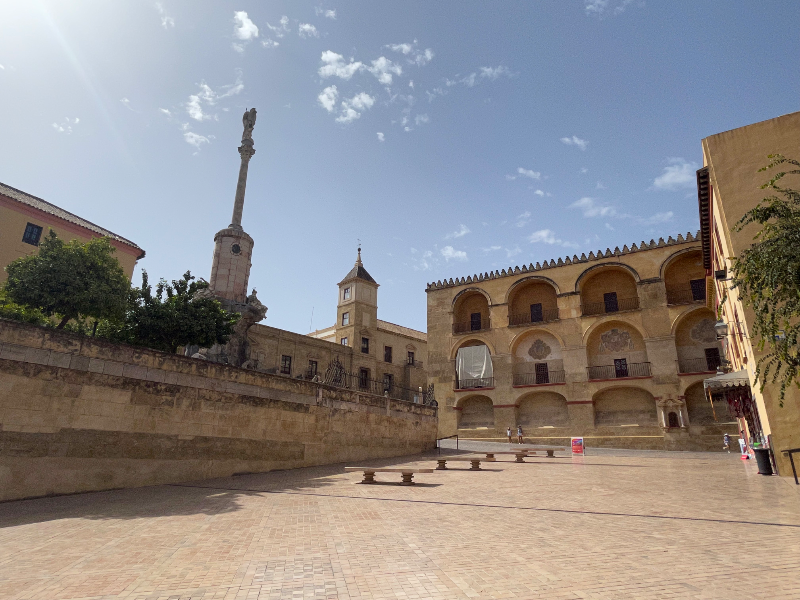
Abd al-Rahman I had it built in 785 on the foundations of a Visigothic church, before three successive caliphs tripled its surface. The result is a forest of over 850 columns of marble, jasper and granite — salvaged from Roman and Visigothic buildings — topped with red-and-white double arches repeating endlessly. You move through it without bearings, in a half-light deliberately disproportionate to human scale, up to the mihrab, a niche facing Mecca and the summit of Umayyad art in the West, covered in gilded mosaics offered by the Byzantine emperor himself.
- Online ticket recommended — tickets.mezquita-catedraldecordoba.es
A cathedral within the mosque
Cathedral
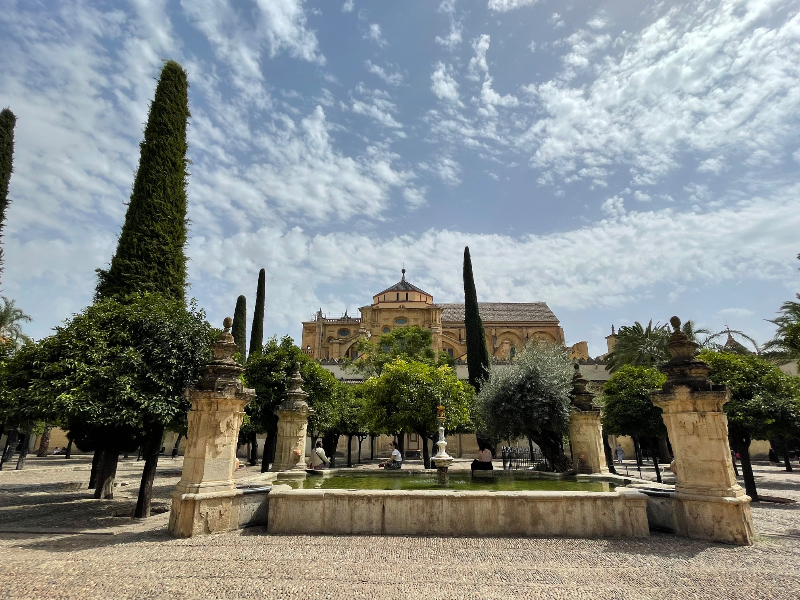
In 1523, Charles V authorised, despite the city council's opposition, the insertion of a Gothic and Renaissance nave at the very heart of the Islamic building. The striking result juxtaposes star vaults, mahogany choir stalls and a baroque altarpiece amid the forest of columns — so much so that the emperor, visiting the finished works, is said to have regretted "destroying what was unique in the world to build what one finds everywhere." The Patio de los Naranjos, once an ablutions courtyard planted with orange trees before prayer, now serves as the forecourt, dominated by the bell tower that swallowed the old minaret.
Twelve patios, one palace
Palacio de Viana
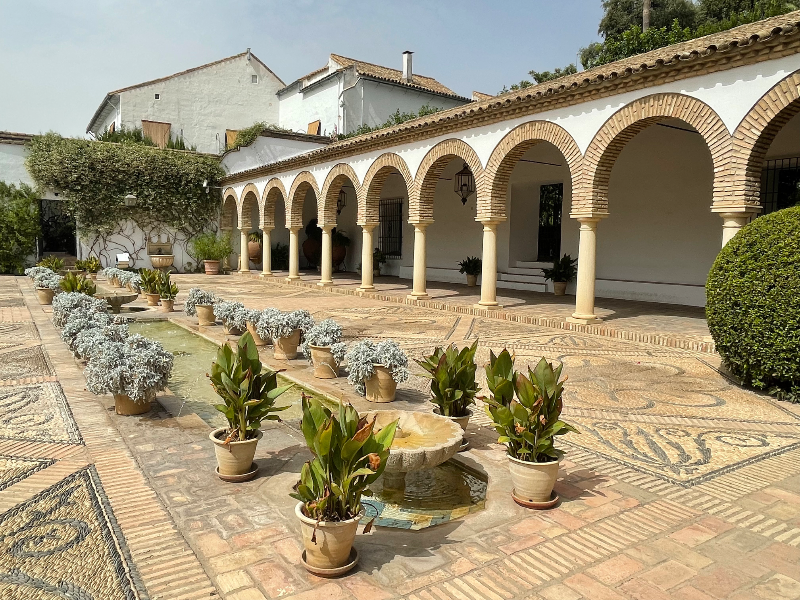
This 15th-century aristocratic residence, expanded generation after generation by the Marquises of Viana, is visited as a stroll through twelve patios, each with its own character: here citrus trees and a central fountain, there stone colonnades and azulejos, elsewhere a wilder garden. It is the quintessence of the Cordoban tradition of the flowering patio, the very one celebrated every May by the Fiesta de los Patios, listed as UNESCO intangible heritage. Take the time to wander rather than rushing through it with the rest of the day.
- Tickets — tickets.palaciodeviana.com
03
Granada — the Alhambra and the Albayzín
Alhambra · Generalife · Palais Nasrides
The summit of Islamic art in the West, a red fortress overlooking the whole plain.
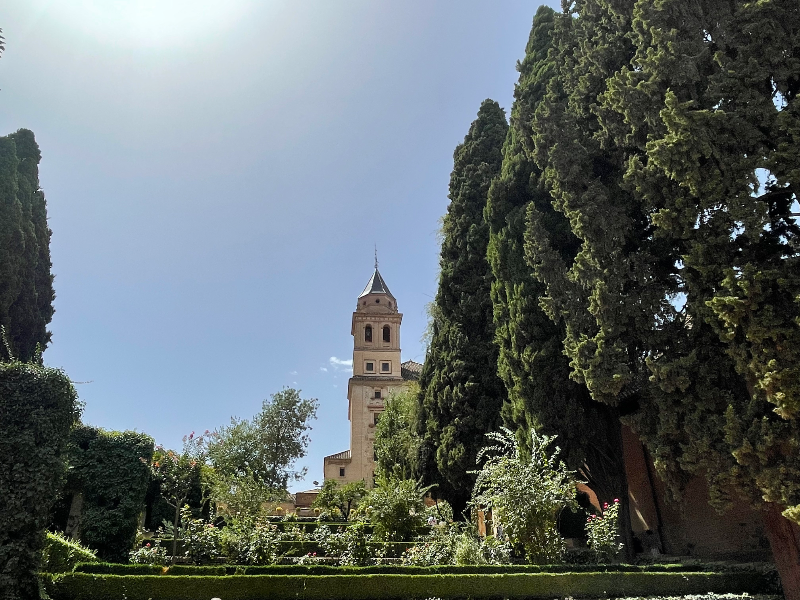
The Nasrid palace
Alhambra, Generalife & the Nasrid Palaces
A fortress and later the residence of the Nasrid sultans from the 13th century onward, the Alhambra owes its name to the reddish earthen walls that enclose it — al-hamra, "the red one" in Arabic. Here you find the Nasrid Palaces, where every room endlessly unfolds carved stucco, muqarnas ceilings and calligraphic inscriptions celebrating God and the sultan's power; the older Alcazaba military fortress, whose keep overlooks the entire plain of Granada; and the Generalife, a summer palace of terraced gardens, water patios and fountains that gave the sovereigns respite from court life. The whole complex, a UNESCO World Heritage site, remains one of the summits of Islamic art in the West.
« Each stop tells a different century of al-Andalus. »
04
Malaga — between sea and the Caminito del Rey
Théâtre romain
Two thousand years of history layered on a single site, between ancient Rome and Islamic Malaga.
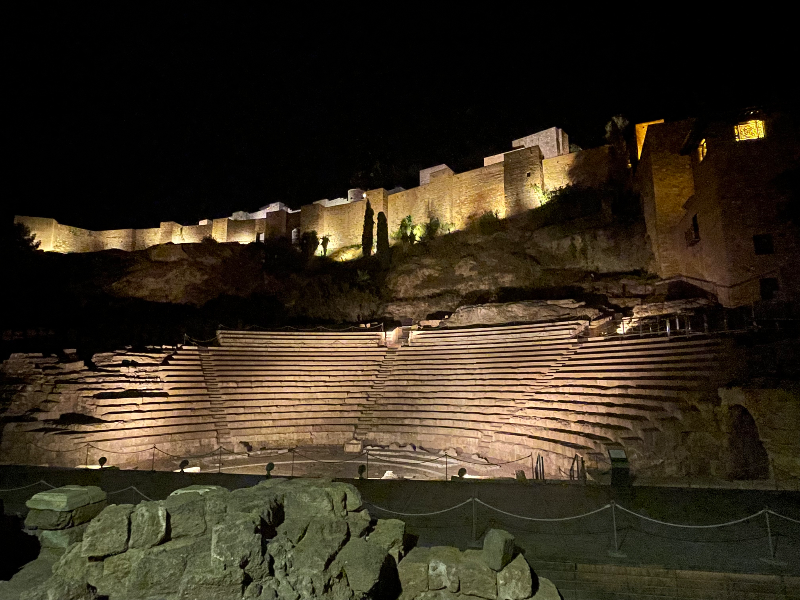
Beneath the city's foundations
Roman Theatre
Discovered by chance in 1951 during construction work, this 1st-century BC theatre lay buried beneath the city for almost two thousand years. It can be visited for free, in the open air, right at the foot of the Alcazaba, whose Moorish walls loom over the stage — a striking shortcut between ancient Rome and Islamic Malaga, layered on the same site. After dark, the lighting brings out the stone tiers and the wall above them.
05
Ronda & the white villages
Puente Nuevo · Arcos de la Frontera · Setenil de las Bodegas
A dizzying gorge and a route of whitewashed villages perched in the Sierra.
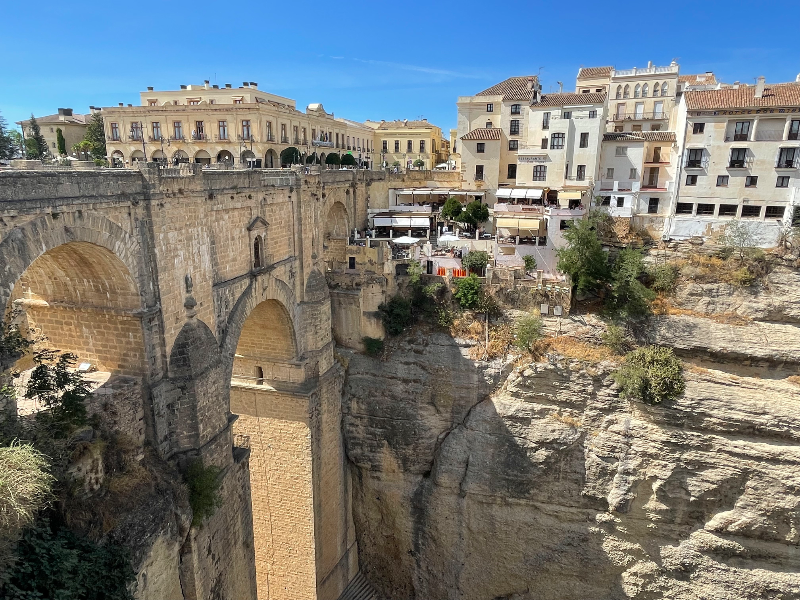
Perched over the Tajo gorge
Ronda
Ronda sits on a rocky spur split in two by the Tajo gorge, a canyon over a hundred metres deep carved by the Guadalevín river. The Puente Nuevo, an 18th-century feat of engineering, links the old Moorish town to the Christian city and offers the most vertiginous view over the void — it's also reached via a staircase descending to the bottom of the gorge. All around, the ramparts, the Santo Domingo convent, the bullring — among the oldest in Spain and the cradle of modern bullfighting — the Casa del Gigante and the Palacio Mondragón make up a half-day's walking visit, in one of the most spectacular white towns of the Sierra.
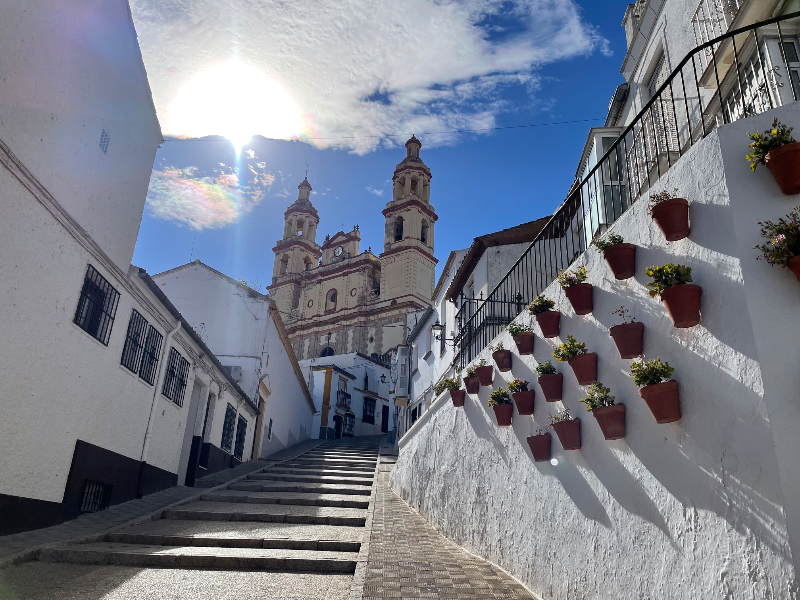
The pueblos blancos route
White villages
A route to plan around the time available, prioritising Arcos de la Frontera and Setenil de las Bodegas. Priority goes to Arcos de la Frontera, perched on its rocky spur above the Guadalete, to Setenil de las Bodegas, whose houses are literally wedged beneath a rock overhang, and to Olvera, crowned by its Moorish castle and neoclassical church. If time allows, the route can extend to Vejer de la Frontera, Grazalema at the heart of the natural park of the same name, and Zahara de la Sierra, overlooking its turquoise reservoir lake.
Tell us when, we'll tell you where.
That's the Les Voyagistes principle: tell us your dates, and we'll reveal the destinations that are in perfect season — Andalusia is best in spring and autumn.
Find my destinations →A route that ends atop a gorge, just as it began beneath the orange trees.